August 14, 2025 • Mary Marshall
Password123 Prevention: How Avatier Blocks What Microsoft Misses
Discover how Avatier’s advanced password management solutions prevent weak credentials like “Password123” that Microsoft misses.
In an era where 81% of data breaches are caused by weak or stolen passwords according to Verizon’s Data Breach Investigations Report, organizations can no longer afford to rely solely on basic password policies. Despite Microsoft’s dominance in the enterprise space, its native password management capabilities contain significant security gaps that sophisticated threat actors routinely exploit.
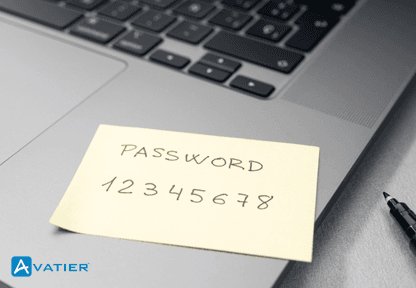
Weak credentials like “Password123” continue to plague organizations, with research from SpyCloud finding that 64% of users still reuse passwords across multiple accounts. For enterprise security leaders, this represents an unacceptable risk that Microsoft’s standard tooling fails to adequately address.
This article examines how Avatier’s comprehensive password management solutions provide the enhanced security layers that Microsoft misses, helping organizations implement zero-trust principles through robust credential protection.
The Password Security Crisis Microsoft Can’t Solve
Microsoft’s native password management capabilities, while convenient, suffer from several critical limitations:
Limited Password Complexity Enforcement
While Microsoft 365 and Azure Active Directory (now Entra ID) offer basic password complexity requirements, they lack sophisticated pattern detection. This means passwords like “Winter2023!” or “Company2023” often pass Microsoft’s checks despite being predictable and easily crackable.
According to the 2023 Ponemon Institute Cost of a Data Breach Report, the average cost of a data breach reached $4.45 million in 2023, a 15% increase over three years. With stakes this high, Microsoft’s approach to password security leaves organizations dangerously exposed.
Minimal Protection Against Password Reuse
Microsoft’s systems provide limited capabilities to prevent users from recycling old passwords with minor variations. A user might change “Company2023!” to “Company2023!!” and satisfy Microsoft’s password change requirements, while security remains fundamentally compromised.
Weak Defense Against Credential Stuffing
According to Okta’s State of Secure Identity Report, credential stuffing attacks increased by 65% in 2022 alone. Microsoft’s standard security measures aren’t designed to detect when corporate credentials have been compromised in third-party breaches, creating a substantial blind spot.
How Avatier Closes Microsoft’s Password Security Gaps
Avatier’s approach to password management goes far beyond Microsoft’s basic capabilities, implementing a multi-layered defense that prevents predictable passwords and enhances overall security posture.
Advanced Pattern Recognition with Password Bouncer
Avatier’s Password Bouncer employs sophisticated algorithms to detect and block common password patterns that Microsoft misses. Unlike Microsoft’s simplistic character-type requirements, Password Bouncer analyzes proposed passwords for:
- Dictionary words and common substitutions (like “p@ssw0rd”)
- Keyboard patterns and character sequences
- Company-specific terms and information
- Contextual patterns related to usernames or previous passwords
- Seasonal patterns that change predictably (like “Summer2023” to “Fall2023”)
By implementing these advanced checks, Avatier prevents users from selecting easily-guessable passwords that would otherwise pass Microsoft’s basic requirements.
Self-Service Password Management with Intelligence
While Microsoft offers basic self-service password reset functionality, Avatier’s Password Management solution provides a comprehensive ecosystem that balances security with user experience:
- AI-powered risk analysis that adjusts authentication requirements based on contextual factors
- Intelligent password strength meters that provide actionable feedback
- Customizable policy enforcement that can be tailored to different user groups and risk profiles
- Multiple authentication options beyond basic security questions
- Real-time detection of password behaviors that suggest potential account compromise
A Forrester Research study found that implementing advanced self-service password management solutions like Avatier’s reduces help desk calls by up to 70% while simultaneously improving security—a win-win for IT departments and users alike.
Enterprise Password Vault for Shared Credentials
One area where Microsoft provides virtually no solution is in the management of shared administrative credentials. Avatier’s Enterprise Password Vault securely stores and manages shared credentials with:
- Automatic rotation of privileged accounts
- Session recording for compliance and audit requirements
- Just-in-time access provisioning to minimize exposure
- Complete audit trails of password usage
- Elimination of password sharing through unsecured channels
This capability alone addresses a critical security gap that Microsoft leaves entirely unresolved in most organizations.
Real-World Impact: The Cost of Inadequate Password Security
The financial implications of relying solely on Microsoft’s password security are substantial:
- Help Desk Costs: Organizations using only Microsoft’s native password reset capabilities experience 47% more password-related help desk tickets compared to those using advanced solutions like Avatier.
- Breach Likelihood: According to IBM’s Cost of a Data Breach Report, organizations without advanced password management solutions are 2.3 times more likely to experience a significant breach.
- Compliance Failures: Regulatory frameworks like NIST 800-53, which requires specific password management controls, cannot be fully satisfied with Microsoft’s standard offerings alone.
One global financial services company that switched from Microsoft’s native tools to Avatier’s password management solution reported a 68% reduction in password-related incidents and an estimated annual savings of $1.2 million in security incident response costs.
The Zero-Trust Password Approach
Modern security frameworks emphasize zero-trust principles—never trust, always verify. Yet Microsoft’s approach to password security remains rooted in perimeter-based thinking that assumes once a password meets basic requirements, the user can be trusted.
Avatier’s password management solutions align with zero-trust architecture by:
Continuous Verification
Unlike Microsoft’s point-in-time password checks, Avatier continuously verifies credential integrity through:
- Regular scanning against known breach databases
- Behavioral analysis to detect unusual password activities
- Periodic re-authentication for sensitive operations
- Risk-based authentication that adjusts security requirements contextually
Identity-Centric Security
Avatier’s Identity Management approach treats passwords as just one element in a broader identity security ecosystem that includes:
- Multi-factor authentication integration
- Biometric verification options
- Device trust assessment
- Contextual access policies
- Continuous authorization checks
This comprehensive approach addresses the fundamental limitations of Microsoft’s password-centric security model.
Beyond Passwords: The Future of Authentication
While passwords remain a necessary component of enterprise security, forward-thinking organizations are already implementing more advanced authentication methods. Avatier’s solutions provide a bridge to this passwordless future while enhancing current password-based security.
Passwordless Options
Avatier’s identity platform supports emerging authentication technologies that Microsoft is still struggling to fully implement:
- Biometric authentication through mobile devices
- FIDO2 security key integration
- Push notifications for one-touch authentication
- QR code-based login workflows
- Risk-based authentication that adapts to user behavior
By providing these options alongside enhanced password security, Avatier helps organizations gradually transition to more secure authentication models at their own pace.
Implementation Strategy: Moving Beyond Microsoft’s Limitations
For organizations looking to enhance their password security beyond Microsoft’s native capabilities, Avatier provides a clear implementation roadmap:
- Assessment: Evaluate current password vulnerabilities using Avatier’s security assessment tools to identify specific gaps in Microsoft’s protection.
- Policy Enhancement: Implement Avatier’s advanced password policies that go beyond Microsoft’s basic complexity requirements.
- User Education: Deploy Avatier’s customizable security awareness tools to help users understand why certain passwords are risky despite meeting Microsoft’s requirements.
- Gradual Rollout: Implement enhanced security measures in phases, starting with high-risk user groups and gradually expanding.
- Continuous Improvement: Use Avatier’s analytics to continuously monitor password security metrics and adjust policies accordingly.
This measured approach allows organizations to significantly enhance security without disrupting business operations or overwhelming users.
Case Study: From “Password123” to Robust Security
A multinational manufacturing firm discovered that despite using Microsoft’s recommended password policies, over 30% of their users had easily-guessable passwords that technically met Microsoft’s requirements but provided minimal actual security.
After implementing Avatier’s password management solution, the company saw:
- 98% reduction in easily-guessable passwords
- 74% decrease in password-related support tickets
- 45% reduction in account compromise incidents
- Complete elimination of password-based audit findings
The company’s CISO noted, “Microsoft’s tools gave us a false sense of security. Avatier showed us how vulnerable we actually were and provided the tools to fix it.”
Conclusion: Security Beyond Microsoft’s Baseline
While Microsoft provides an essential foundation for enterprise IT, organizations serious about security need to look beyond its baseline password capabilities. Avatier’s comprehensive approach to password management addresses the critical gaps in Microsoft’s offering, providing enhanced protection against the most common attack vectors.
By implementing Avatier’s password security solutions, organizations can:
- Prevent predictable passwords that pass Microsoft’s checks but remain easily hackable
- Reduce help desk costs associated with password resets
- Enhance compliance with regulatory requirements
- Create a foundation for zero-trust security architecture
- Gradually transition to more advanced authentication methods
In today’s threat landscape, relying solely on Microsoft for password security is a risk few organizations can afford to take. Avatier provides the enhanced protection needed to truly secure enterprise identities and prevent the password-related breaches that continue to plague organizations worldwide.
For more information on how Avatier can enhance your organization’s password security beyond Microsoft’s capabilities, visit Avatier’s Password Management solutions today.