December 11, 2025 • Mary Marshall
Passwordless for Healthcare: HIPAA Compliance Without Passwords
Discover how passwordless identity management helps healthcare organizations achieve HIPAA compliance, and protect patient data.
Passwords are quietly killing healthcare security. Clinicians share login credentials at nursing stations. IT teams field hundreds of password reset tickets weekly. And attackers exploit stolen credentials to access electronic health records (EHRs) faster than security teams can respond. For healthcare organizations navigating the pressures of HIPAA compliance, staff burnout, and relentless cyber threats, the status quo is no longer sustainable.
The solution isn’t another password policy. It’s eliminating passwords altogether.
Passwordless authentication is rapidly reshaping how healthcare IT leaders approach both security and compliance. When combined with AI-driven identity management, it creates a framework where access is seamless for clinicians, auditable for compliance officers, and dramatically more secure for patients whose data depends on it.
Why Passwords Are a Healthcare Security Crisis
The numbers are sobering. According to the Verizon Data Breach Investigations Report, over 80% of hacking-related breaches involve compromised or weak credentials. In healthcare, where a single breach can expose millions of patient records and trigger federal investigations, credential-based attacks aren’t a theoretical risk — they’re a daily reality.
The U.S. Department of Health and Human Services (HHS) reports that healthcare data breaches cost the industry an average of $10.9 million per incident — the highest of any sector for 13 consecutive years, according to IBM’s Cost of a Data Breach Report. HIPAA violations compound those costs with fines ranging from $100 to $50,000 per violation, with annual maximums reaching $1.9 million per violation category.
Despite this, many healthcare organizations still rely on shared passwords, static credentials, and manual password reset processes that drain IT resources and leave critical systems exposed.
What HIPAA Actually Requires (And Where Passwords Fall Short)
HIPAA’s Security Rule requires covered entities to implement technical safeguards that control access to electronic Protected Health Information (ePHI). Specifically, the rule mandates:
- Unique user identification — each user must have a unique ID for tracking access
- Automatic logoff — systems must terminate sessions after inactivity
- Encryption and decryption — ePHI must be protected in transit and at rest
- Audit controls — hardware, software, and procedural mechanisms to examine system activity
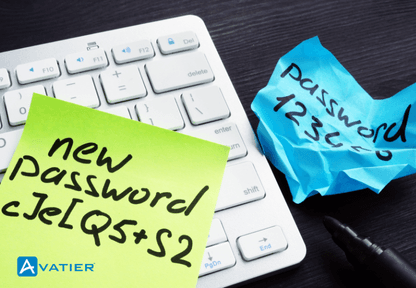
Passwords technically satisfy the “unique user identification” requirement, but they fail in practice. Shared credentials violate the spirit of unique identification. Sticky notes with passwords undermine encryption protocols. Manual reset processes create audit gaps. HIPAA was written before passwordless technology matured — but the regulation’s intent maps perfectly to what modern passwordless authentication delivers.
Avatier’s HIPAA-compliant identity management solutions are purpose-built to meet these technical safeguard requirements while eliminating the credential risks that passwords introduce.
The Case for Passwordless in Clinical Environments
Healthcare environments present unique identity challenges that generic enterprise IAM solutions weren’t designed to handle:
- Shared workstations at nursing stations and care coordination hubs
- High-urgency access needs where authentication friction costs precious seconds
- Rapid role transitions as staff float between departments and facilities
- Contractor and vendor access requiring temporary, auditable credentials
- Mobile and remote access for telehealth and field-based providers
Passwordless authentication — whether through biometrics, hardware tokens, smart cards, or push-based mobile authentication — solves these challenges simultaneously. Clinicians tap a badge or use a fingerprint and immediately access the systems they need. No forgotten passwords. No help desk tickets. No shared credentials.
This is where Avatier’s Identity Anywhere Password Management platform stands apart from competitors like Okta and Ping Identity. Rather than bolting passwordless capabilities onto a legacy password management architecture, Avatier’s platform is designed around zero-trust principles from the ground up — meaning every access request is verified, every session is logged, and every identity is continuously authenticated without requiring users to manage a single password.
How Avatier Enables Passwordless Without Sacrificing HIPAA Compliance
Avatier’s approach to passwordless healthcare identity combines several critical capabilities:
AI-Driven Access Intelligence
Avatier’s AI-driven identity engine continuously analyzes access patterns, flags anomalous behavior, and enforces least-privilege principles automatically. If a nurse practitioner suddenly attempts to access oncology records outside their normal department scope, the system flags and quarantines that access event in real time — generating the audit trail HIPAA demands.
Multifactor Authentication Without Passwords
Avatier’s multifactor authentication integration supports a wide range of passwordless authentication methods, including biometrics, hardware tokens, push notifications, and smart cards. Healthcare organizations can tailor authentication requirements to the sensitivity of the data being accessed — a higher-assurance method for accessing controlled substance records, streamlined biometric authentication for routine EHR access.
Self-Service, Zero Helpdesk Friction
One of the most overlooked costs in healthcare IT is help desk overhead tied to password resets. Gartner estimates that between 20% and 50% of all help desk calls are password-related, costing organizations an average of $70 per reset. For a 5,000-employee health system, that translates to hundreds of thousands of dollars annually in preventable IT labor costs.
Avatier’s self-service identity platform eliminates this overhead. Users verify their identity through secure, policy-driven channels — and the system handles the rest automatically. No tickets, no waiting, no shared credentials created out of frustration.
Automated User Provisioning for Clinical Staff
High staff turnover and credential sprawl are endemic to healthcare. Traveling nurses, seasonal staff, and rotating residents create a constant cycle of provisioning and deprovisioning — and every orphaned account is a potential HIPAA violation waiting to happen.
Avatier’s automated user provisioning ensures that when a clinician joins, transfers, or leaves an organization, their access rights are updated instantly and automatically. Access is granted based on role, department, and least-privilege policies — with no manual IT intervention required. This directly supports HIPAA’s requirement for unique user identification and access control.
Competing Solutions Leave Healthcare Exposed
Healthcare organizations evaluating Okta, Ping Identity, or SailPoint for passwordless deployments frequently encounter the same friction points: complex implementation timelines, costly professional services engagements, and solutions designed for enterprise IT environments rather than the fast-moving, high-stakes world of clinical care.
SailPoint customers in healthcare have reported that identity governance configurations require months of customization before they meet HIPAA audit requirements. Okta’s passwordless features, while capable, are tied to a broader pricing model that scales costs quickly for organizations with large contractor and temporary workforce populations.
Avatier takes a different approach: a containerized, deployment-flexible architecture that organizations can run in their own environment — on-premises, in a private cloud, or in a hybrid configuration — giving healthcare IT leaders control over data residency and compliance posture. Avatier’s Identity-as-a-Container (IDaaC) model means sensitive patient access data never has to leave your environment to power world-class passwordless authentication.
Building a HIPAA-Ready Passwordless Strategy
Transitioning to passwordless in a healthcare environment doesn’t happen overnight, but the path is clearer than most IT leaders expect. A practical roadmap looks like this:
Phase 1 — Audit and Baseline Identify all systems touching ePHI. Map current authentication methods. Document where shared credentials, static passwords, or manual reset processes exist. This becomes your compliance gap analysis.
Phase 2 — Deploy Passwordless Authentication for High-Risk Access Points Prioritize EHR systems, pharmacy management, controlled substance logging, and telehealth platforms. These are the highest-risk access points and the most likely targets for credential-based attacks.
Phase 3 — Automate Provisioning and Deprovisioning Integrate Avatier’s automated provisioning workflows with your HR system of record. Ensure that every new hire, transfer, and termination triggers immediate, policy-driven access changes — with full audit logs generated automatically.
Phase 4 — Continuous Monitoring and Certification Use Avatier’s AI-driven access governance to run continuous access certifications. Identify and remediate access anomalies before they become HIPAA violations. Generate compliance reports on demand for auditors.
The Bottom Line: Passwordless Is Proactive HIPAA Compliance
HIPAA compliance has historically been treated as a checklist exercise — something done for auditors, not for patients. Passwordless identity management changes that calculus entirely. When every access event is authenticated, logged, and governed by intelligent automation, compliance becomes a byproduct of good security — not a burdensome overlay.
Healthcare organizations that continue to rely on passwords are accepting unnecessary risk: the risk of a breach, the risk of a regulatory fine, and the risk of eroding the patient trust that every healthcare institution depends on.
Avatier’s HIPAA-compliant identity management platform gives healthcare IT and security leaders the tools to move beyond passwords — without moving beyond the compliance boundaries that protect patients and organizations alike.
The question is no longer whether passwordless is ready for healthcare. It’s whether your organization is ready to stop letting passwords define your security posture.
Ready to eliminate passwords from your healthcare environment? Explore Avatier Identity Anywhere Password Management and discover how leading health systems are achieving HIPAA compliance without a single password in sight.